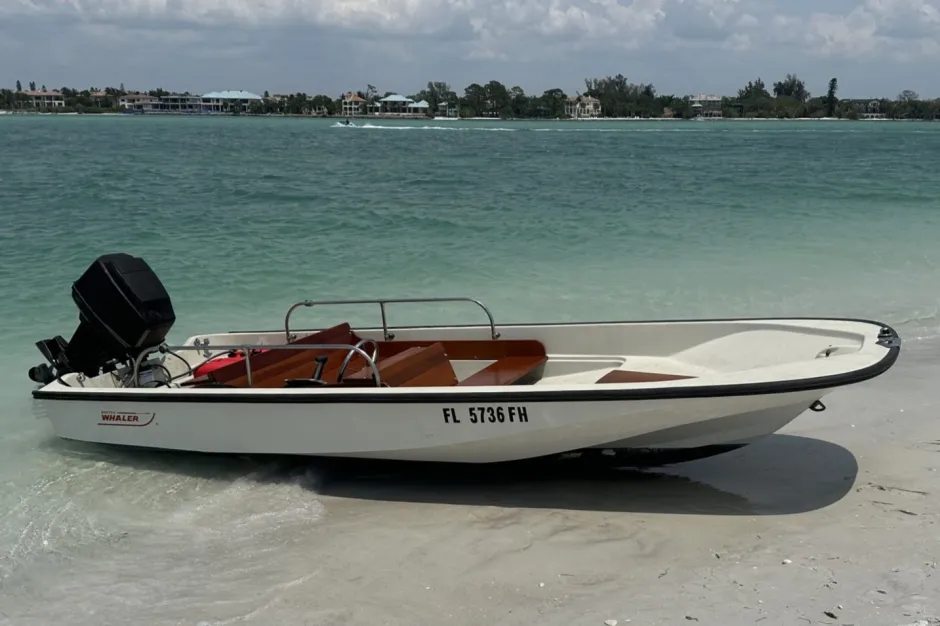

Boston Whaler built its reputation on a single stunt. In 1961, founder Dick Fisher sawed a 13-foot Whaler in half, sat in the back section, and drove it around the harbor while the front half floated nearby. The boat didn’t sink. It couldn’t. The hull was filled with closed-cell foam, a construction method Fisher called Unibond, and that foam meant the boat was positively buoyant even when fully swamped. The ads called it “unsinkable,” and for once the marketing wasn’t lying. Sixty years later, those same 13-, 15-, and 17-foot hulls are still out there, and the ones built before the company started trading hands and cutting costs are some of the most durable small boats ever made.
The market for these boats is surprisingly accessible if you know what you’re looking at. A rough but structurally sound 13-foot Whaler from the 1970s to 80s can still be found for $7,000 to $9,000, sometimes less if the trailer is rusted and the outboard is shot. A cleaner example with a running motor will run you $10,000 to $13,000. The 15-foot Super Sport models from the late 70s and early 80s trade in the $8,000 to $15,000 range depending on condition. The 17-foot Montauk, the most desirable all-around classic Whaler, typically sits between $12,000 and $25,000 for a boat that’s been cared for, though basket cases show up for half that. The key is the hull. Boston Whaler’s foam core construction means there’s no stringer system to rot, no wood in the transom to go soft. If the hull hasn’t been punctured and waterlogged (and you can tell by the weight, a saturated hull feels noticeably heavy) the bones are good. Everything else is replaceable.
That’s where shops like FassēCo come in. Read and Julie Fasse run their restoration operation out of South Carolina, and what they do is closer to art than repair. Now they hand-pick donor boats from all over the eastern US, strip them to bare hulls, solvent-wash and sand away decades of contaminants, grind out every crack and screw hole, re-glass and fair the surface with marine-grade fillers, then prime and topcoat with two-part polyurethane finishes from Alexseal. The wood interiors are solid hardwood finished with Epifanes and Semco. The metalwork is stripped, shaped, chromed, and polished back to life. Every boat gets completely rewired, new fuel lines, custom tanks, Racor fuel water separators, Seastar hydraulic steering, and a Yamaha four-stroke outboard matched to the hull. A full FassēCo restoration is built to order (they’ve done over forty boats, each one named after the owner) and while they don’t publish pricing publicly, a ground-up restoration of a 15- or 17-foot Whaler with new power typically runs above sticker of a new all fiberglass whaler depending on the hull, the level of customization, and the cost of the donor boat. That sounds like a lot until you price a new 17-foot Montauk from a dealer, which starts around $45,000 with a basic rig and climbs fast. The FassēCo boat is hand-finished with better materials, better attention to detail, and a classic hull that will hold its value and possibly appreciate while the new boat depreciates the moment it leaves the showroom.
There’s another name in this world worth knowing, and that’s Cherry Restoration. Less documented online than FassēCo, but the same ethos applies: find a classic Whaler with good bones, strip it to the hull, and rebuild it with better materials and more care than the factory ever used. The math works the same way whether you’re paying a shop or doing it yourself. A solid donor hull for $7,000, a new Yamaha four-stroke for $8,000 to $12,000, and a few thousand more in materials if you’re handy with fiberglass and wiring, and you’ve got a boat that will outlast anything on the showroom floor for under $25,000 all in.
LaidFactor Comment: Vintage Boston Whalers are the boat equivalent of a 100 Series Land Cruiser. Overbuilt, under complicated, and still running decades after the warranty expired. The 13-, 15-, and 17-foot hulls from the 60s through the 80s are the ones to look for. Donor boats with good bones start around $5,000 to $7,000. Clean runners go for $10,000 to $15,000. If you can do the work yourself, you’re into a better-than-new Whaler for under $25,000. Look for a hull that hasn’t been waterlogged. Everything else can be fixed. That’s the ratio. That’s the lens. — LF
